

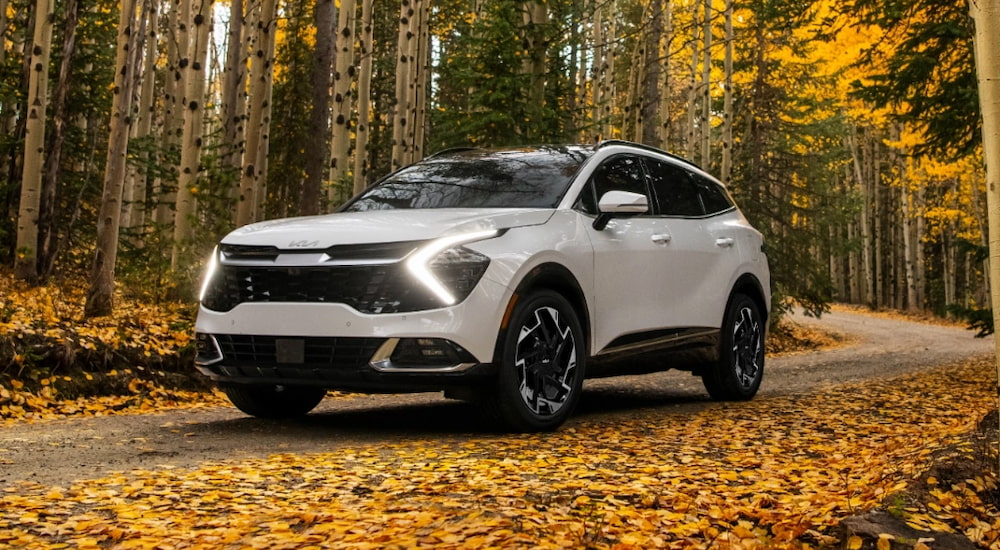
The compact SUV is a popular body style because it’s highly versatile, with an easily re-configured interior perfect for transporting people, cargo, or a bit of each, tends to have an accessible price point, and strikes a good balance between having a spacious interior and not having such a large footprint that it’s cumbersome to drive or hard to park. So when you see the Kia Sportage for sale, you might find its dimensions and offerings fairly familiar. How does the Sportage stand out from the competition in a crowded field? What makes it worth considering over other compact SUVs?
Today, we’re going to answer those questions by putting the 2025 Sportage head-to-head with the bestselling 2025 Toyota RAV4. There’s a lot that these two models have in common: they both have a good lineup of trims; both offer gas, hybrid, and plug-in hybrid variants; and both offer a choice between front-wheel drive and all-wheel drive, so you can prioritize either fuel economy or traction. But in this matchup, we’re going to be focusing on the things that differentiate the two to see which one has more to offer drivers.
Interior Space
Step inside the cabin of the Sportage, and you’ll find a fresh, modern space. Controls blend in with the dashboard, and the large infotainment screen is well incorporated into the overall design. By contrast, the RAV4 feels a bit dated, with a screen that looks like an iPad clumsily attached to the dash and a less refined feel overall. There’s a good reason why the interior looks less modern: the RAV4 hasn’t had a redesign since the 2019 model year, while the Sportage was redesigned more recently for 2023.
But in an SUV, design is always going to play second fiddle to what people are really looking for in this class: space. In this regard, the Sportage also has more to offer. While the two models have similar overall dimensions, Kia comes out ahead in two key categories: rear seat legroom and cargo volume. The Sportage technically offers more front legroom as well, but it’s less than an inch and not likely to be noticeable. The extra 3.5 inches in the back, however, can mean the difference between a pleasant road trip and a torturous hours-long drive for backseat passengers whose growth spurts are behind them. The 2025 Kia Sportage offers 39.6 cu.ft. of space behind the back seat and an impressive 74.1 cu.ft. of max cargo space behind the first row. The 2025 Toyota RAV4 offers only 37.6 cu.ft of space behind the rear seats and 69.8 cu.ft. of max cargo space. The Sportage’s extra two cubic feet of cargo volume behind the back seat are somewhere in the middle, not likely to affect your everyday life, but might just be a lifesaver if you’re packing up everything that needs to fit in your college-bound teen’s dorm room, picking up a bulky piece of furniture to avoid a high delivery fee, or picking a friend or family member who doesn’t travel light up from the airport.

Infotainment System
In order to offer drivers on a budget a low price on an entry-level model, both the Sportage and the RAV4 come standard with an 8-inch touchscreen display on their base trims (the Sportage LX and the RAV4 LE). But beyond that similarity, there’s a lot that separates the infotainment offerings of the two SUVs. For one thing, the Sportage’s more premium setup has a 12.3-inch touchscreen that’s integrated nicely into the interior design, extending from the digital instrument display for a smooth look. The RAV4’s smaller 10.5-inch display is clunkier and not as easy to read at a glance.
On top of that, the Sportage offers the premium system as standard on every trim beyond the LX, so you can still get it on a model with a starting MSRP under $30k by opting for the EX.[a] On the RAV4, you’re stuck with the small screen on both the LE and XLE trims and need to add on an optional package to upgrade to the larger option on the XLE Premium, requiring you to pay extra on top of that trim’s starting MSRP of $33,650. Only the top-tier Limited trim offers the larger touchscreen as standard fare. The same is true for another convenient feature: a wireless device charger. This comes standard on the Sportage EX, but follows the same pattern as the large touchscreen on the RAV4.
So, while both SUVs will give you a reasonable infotainment setup, complete with Apple CarPlay, Android Auto, multiple USB ports, and Bluetooth connectivity, the Sportage has a better setup that’s more widely available. You don’t need to pay as much money to access the more premium setup, making it more accessible to people with a tight budget. And even if money is no concern, you’re better off choosing the Sportage and ending up with a bigger and better-positioned screen.
Safety Features
Overall, both of these models are well-built SUVs with 5-star safety ratings from the National Highway Traffic Safety Administration. But of the two, only the Sportage has been named a Top Safety Pick by the Insurance Institute for Highway Safety for its 2025 model. When it comes to driver assist features, both models come standard with a solid lineup of features, including automatic emergency braking, lane keep assistance, and automatic high beam headlights. Upgrade to a higher trim on each of these models, and you can unlock features like a blind spot monitor, rear cross-traffic assistance, rear automatic braking, and a 360º view that gives you a top-down look at the entire area around your vehicle. Together, these features make it easy to stay aware of your surroundings and avoid danger.

Warranty Coverage
Having good warranty coverage can take a load of worry off of your mind. Knowing that you won’t be on your own if something goes wrong with your vehicle is one of the most compelling reasons to opt for a new vehicle and the better the coverage, the more you know that the company stands behind the product they make and expect it to last for the long haul. Given that, let’s take a look at the difference between the warranties Kia provides and their Toyota equivalents.
The basic warranty on the 2025 RAV4 only lasts for 3 years or 36,000 miles, whichever comes first. On the Sportage, you have basic warranty coverage for the first 5 years or 60,000 miles (again, whichever comes first). On just about any vehicle, the basic warranty will be shorter than the powertrain warranty, which covers vital components like the engine. The RAV4’s powertrain warranty is the same length as the Sportage’s basic warranty: 5 years or 60,000 miles. Meanwhile, the Sportage’s powertrain warranty covers an impressive 10 years or 100,000 miles, so you can drive with confidence for a nice, long while before worrying about dealing with any worn-out powertrain components completely on your own.
One place where Toyota does come out ahead is pre-paid maintenance care, which you’ll get for the first 2 years or 25,000 miles that you own a new 2025 RAV4. However, a few oil changes early in your vehicle’s life are probably not going to be as big a deal as possible issues that can arise once a vehicle gets older. If you run into trouble while you’re out and about, you can make use of roadside assistance for the first two years regardless of mileage for the RAV4 or for the first 5 years or 60,000 miles for the Sportage.
Find the Sportage Here at Lupient Kia Milwaukee
There’s no denying that the RAV4 is a popular SUV that has a lot going for it. But when you get into the details, the Sportage just has more to offer across the board. What’s more, it’s also the more affordable option, making this an even easier choice. If you want to see the Sportage for yourself and take it out for a test drive, come visit us here at Lupient Kia Milwaukee. We can’t wait to roll out the red carpet for you.
[a] MSRP may change without notice. See dealer for complete details.
Connect with us


- 2025 Kia Sorento for Sale
- Kia Dealer
- Kia Dealer Near Waukesha
- Kia K5 for Sale
- Kia Sorento for Sale
- Kia Sportage for Sale
- Kia Sportage for Sale in Glendale
- Kia Sportage for Sale in Milwaukee
- Kia Sportage for Sale Near Waukesha
- Kia Telluride for Sale
- Kia Telluride for Sale Near Milwaukee
- Used Kia Dealer
Categories
 Warranties include 10-year/100,000-mile powertrain and 5-year/60,000-mile basic. All warranties and roadside assistance are limited. See retailer for warranty details.
This site is being monitored by one or more third-party software(s), and may capture information about your visit. You may opt-out from the data collection on your visit through a universal consumer options page located at Collection Opt-out Services.